A soft interface between people and information
The Human Information Systems Laboratory at Osaka Metropolitan University, led by Professor Katsuhiro Honda and Associate Professor Seiki Ubukata, studies data analysis and soft computing. This site introduces our research, faculty, learning demos and the careers of our graduate students.
Our research covers knowledge discovery from large databases, such as questionnaire data and internet content, using methods that fuse fuzzy theory with multivariate analysis; data analysis methods for kansei (affective) information that involves vague human value judgments; agent simulations and learning algorithms based on cognitive and kansei models; and the development of information media.
News
Axelidea, led by alumnus Dr. Nishida, wins the Regional Award at NEDO’s GENIAC-PRIZE
Axelidea Inc., whose CEO is our laboratory alumnus Dr. Nishida (Ph.D. in Engineering), received the Regional Award, a special prize of the GENIAC-PRIZE, a generative AI program run by the Ministry of Economy, Trade and Industry (METI) and NEDO. The award was shared with Kuriyama Hosei Co., Ltd.
The winning project, “KATA-LYST AI,” develops an AI agent that turns the tacit knowledge of skilled craftspeople into digital assets. Combining multidimensional data from ultra-compact tactile sensors with video analysis by a Japanese foundation model, it is a skill-transfer platform that makes craftsmanship explicit down to the level of physical laws.
The company has also released “AXELIDEA-QUON-14B-Japanese-v01,” a Japanese-specialized LLM trained on problem-solving patterns distilled from patent documents. It ranks first among non-reasoning 14B-class models on the JA Leaderboard (average of seven Japanese evaluation tasks) (press release, in Japanese).
Research
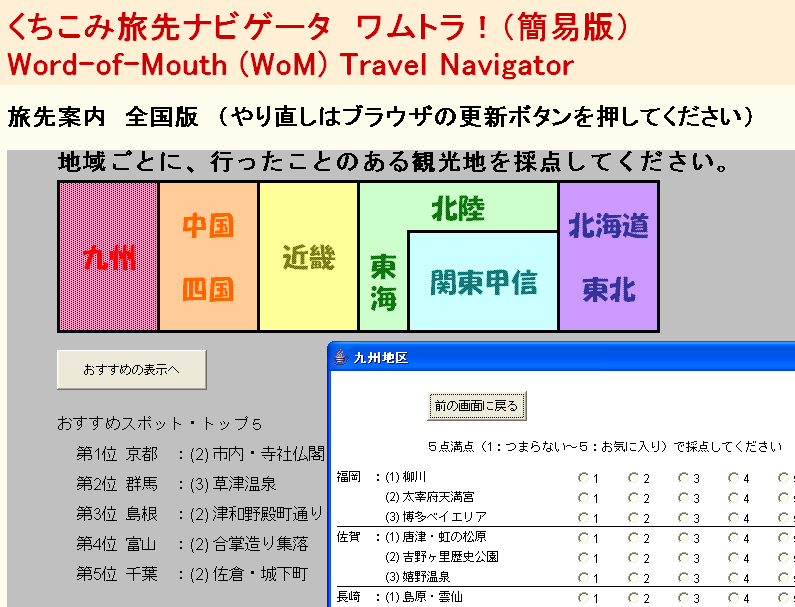
Finding information: a word-of-mouth travel destination navigator
This system applies collaborative filtering to travel destination recommendation. Collaborative filtering estimates how a user would rate items they have not yet rated, based on the similarity of preferences between users, and finds items recommended specifically for that user. The system reproduces “word of mouth” on a computer: hearing about the things that people with tastes similar to yours say they love. We study theories and techniques for estimating unrated values—that is, missing values—from the other observed values in a matrix of ratings that many users have given to various content according to their own preferences.
Data mining that embraces vagueness
From the viewpoint of soft computing—flexible information processing built on fuzzy theory, which blurs boundaries, and rough set theory, which captures information coarsely—we study data mining and knowledge discovery that reflect the vagueness of human judgment. Now that big data is part of everyday life, there is a growing need for clustering techniques that automatically classify huge amounts of data. By taking the vagueness and uncertainty of classification into account, we can achieve clustering that is more flexible, reliable and safe.
- Benign
- Malignant
- Data near the boundary
One group per item
Conventional clustering
Similar data are grouped automatically. Data near the boundary line are also assigned to one group or the other.
Membership by degree
Fuzzy clustering
Membership is a real value between 0 and 1, which handles the vagueness of classification. Data near the boundary belong partly to both groups.
Certain vs. possible
Rough clustering
Each group has a region of data that certainly belong to it (lower approximation) and a region of data that possibly belong to it (upper approximation), which handles the uncertainty of classification. Deciding without the boundary region lowers the risk of misclassification.
Learning algorithms inspired by human thinking
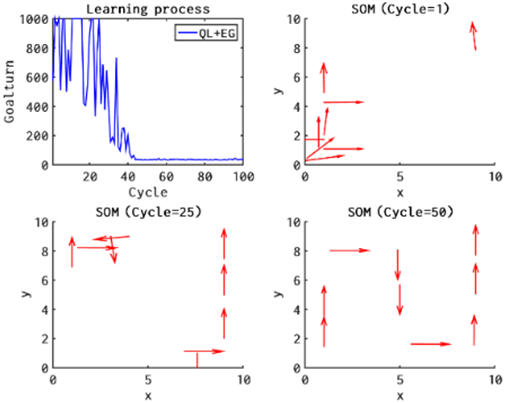
Modern learning algorithms have advanced by refining, through informatics, the ways in which people learn. Adding a cognitive perspective to various learning algorithms makes learning more efficient. The figure uses arrows to show how units modeled on nerve cells roughly capture the learning process as they learn an S-shaped maze. Making good use of such vagueness, rather than avoiding it, enables more efficient learning.
Careers of our graduates
Most of our students go on to the two-year master’s program. Recent employers of our master’s graduates include the following (number of graduates in parentheses).
| FY2025 Hitachi, The Japan Research Institute (2), Accenture, SMBC Nikko Securities, Toyo Engineering, ABeam Consulting |
| FY2024 NEC, Panasonic, Panasonic Connect, MonotaRO, Nara Prefectural Government |
| FY2023 DeNA, Sharp, Panasonic Connect, NS Solutions, NTT DATA KANSAI, ASAHI Net |
| FY2022 SoftBank, Yahoo Japan, NEC, KDDI, SMBC Nikko Securities, OPTAGE, Rengo, MonotaRO |
| FY2021 Panasonic, Daikin Industries, Yahoo Japan, CyberAgent (2), KYOCERA Document Solutions |
Earlier graduates (FY2002–FY2020) joined companies such as Toyota Motor, Honda Motor, Mitsubishi Electric, Daikin Industries, Sumitomo Electric Industries, Hitachi, NEC, Panasonic, Sharp, NTT West, Nomura Research Institute, Kansai Electric Power, Keyence and Fujitsu. The full list is on the Japanese page.